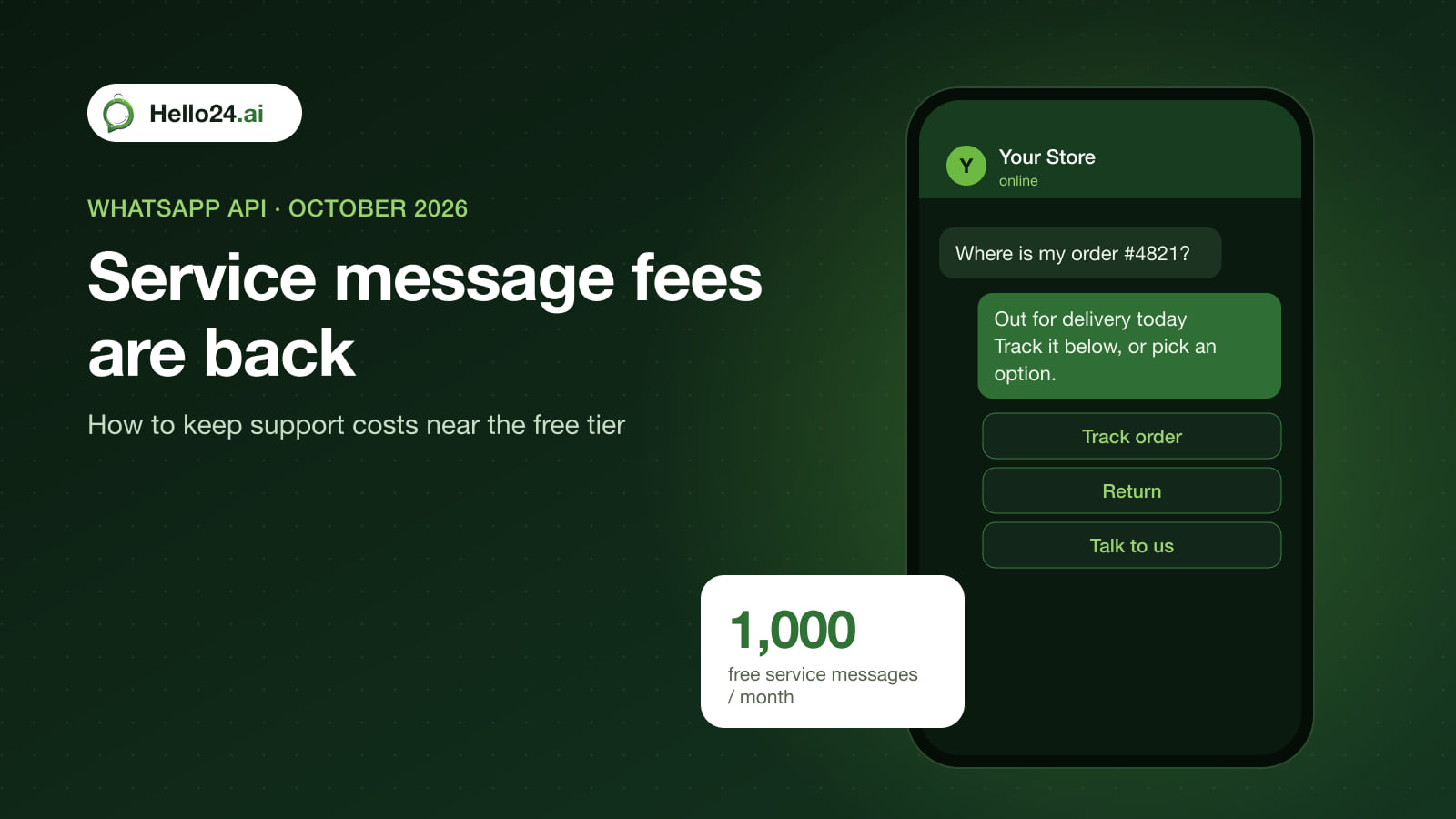
Since 1 October 2026, Meta charges for WhatsApp service messages, the free-form replies a business sends inside the 24-hour customer service window. Each business phone number gets 1,000 free service messages a month; from the 1,001st, every delivered reply is charged at your market’s rate. Service messages had been free since November 2024.
Key facts
| Item | Detail |
|---|---|
| Effective date | 1 October 2026 |
| What is charged | Delivered service (non-template) messages sent by the business, whether a person or a chatbot sends them |
| Free tier | 1,000 delivered service messages per month, per business phone number |
| Free tier reset | Monthly, at midnight in your WhatsApp Business account’s time zone; unused messages don’t roll over |
| Rate | The same as the utility rate in each market (India: ₹0.115 / $0.0014) |
| Customer messages | Always free: you are never charged when a customer messages you |
| Payment method | Without one on file, Meta delivers service messages only until the free tier is used, then stops delivering them |
| Also changed | Utility templates sent inside an open customer service window are now charged too (free from July 2025 until 30 September 2026) |
| Still free | Messages inside a free entry point window (up to 7 days after a click-to-WhatsApp ad or Page call-to-action) |
What the 1,000 free messages cover
The free tier counts messages your business sends, not conversations. If a customer asks one question and your bot replies with four separate texts, that is four service messages. Replies from an AI chatbot count exactly like replies from an agent.
A store that handles 300 support chats a month, with about five replies per chat, sends roughly 1,500 service messages: 1,000 free and 500 charged.
What it costs once you pass 1,000
Service messages cost the same as utility messages. Meta’s list rates per delivered message from 1 October 2026:
| Market | Rate per service message | 5,000 replies a month | 10,000 replies a month |
|---|---|---|---|
| India | ₹0.115 ($0.0014) | ₹460 | ₹1,035 |
| United Kingdom | $0.022 | $88 | $198 |
| Germany | $0.055 | $220 | $495 |
| United Arab Emirates | $0.0157 | $62.80 | $141.30 |
| Saudi Arabia | $0.0107 | $42.80 | $96.30 |
| Indonesia | $0.025 | $100 | $225 |
| Brazil | $0.0068 | $27.20 | $61.20 |
| US and Canada | $0.0034 | $13.60 | $30.60 |
The monthly columns subtract the 1,000 free messages for one phone number. Tax is extra. Check your own mix of marketing, utility and service messages in the free WhatsApp API pricing calculator.
In India the cost is small, but it grows quickly for busy support teams in Europe and the Gulf, and for brands that run several numbers.
Do this first: add a payment method
If your WhatsApp Business account has no payment method, Meta stops delivering service messages once the 1,000 free ones are used. Customers then see no reply at all. Add a card or credit line in Meta’s Billing Hub, or ask your provider whether they bill Meta’s charges for you.
Seven ways to stay near the free tier
- Answer in one message, not four. Combine the greeting, the answer and the next step into one reply. Every extra “Got it!” or “One moment please” is a billed message after the free tier.
- Use buttons and list messages. An interactive list (“Track order / Return / Talk to us”) resolves a chat in fewer turns than open questions. Fewer turns means fewer service messages.
- Prevent “where is my order?” chats. Send shipping and delivery updates proactively as utility templates. One update costs the same as one service reply but stops a three- or four-message support chat before it starts.
- Let a chatbot handle repeat questions completely. A well-built AI chatbot answers order status, returns, sizes and COD questions in a single accurate reply and hands only real problems to a person, so agents don’t re-ask what the bot already collected.
- Stop auto-replies outside hours from stacking. One clear out-of-hours message per chat is enough; don’t repeat it on every customer message.
- Run click-to-WhatsApp ads for pre-sales chats. Conversations that start from those ads open a free entry point window of up to 7 days, and messages in that window aren’t charged.
- Watch the count. Track service messages per number every week. If you regularly pass 1,000, review the busiest conversation types and turn the top ones into buttons, FAQs or proactive updates.
How Hello24 helps
Hello24’s no-code chatbot builder and AI chatbot let you build flows with buttons and lists, answer common questions in one reply, and hand off to the shared team inbox with the full context. Order updates for Shopify and WooCommerce go out automatically as utility templates. Brands using Hello24 automate up to 90% of customer conversations.
Book a demo to see it on your own store, or estimate your monthly WhatsApp bill with the pricing calculator.
Frequently asked questions
Are WhatsApp service messages free in 2026?
Only the first 1,000 each month on each business phone number. Since 1 October 2026, Meta charges every delivered service message after that at the market’s utility rate.
Do chatbot replies count as service messages?
Yes. Any free-form message your business sends inside the 24-hour customer service window is a service message, whether a person or a bot sends it.
Is the 1,000 free tier per business or per phone number?
Per business phone number. A brand with three WhatsApp numbers gets 1,000 free service messages on each number every month.
Am I charged when a customer messages me?
No. Messages a customer sends to your business are never charged.
What happens if I have no payment method?
Meta delivers service messages within the free tier, then stops delivering them for the rest of the month.
Are utility templates inside the 24-hour window still free?
No. From 1 October 2026 they are charged at the normal utility rate, the same as service messages.
Sources
- Meta for Developers: Pricing on the WhatsApp Business Platform (read 16 November 2026)
- Hello24: WhatsApp Business API pricing in India